Week 08 – Research Questions, Variables, and Study Design

1. What Is Research?

Research begins with curiosity — a question about how the world works.
In this course we work with existing datasets, but behind each dataset there is (or should be) a research question.

This week connects your earlier work on data types and levels of measurement (Lecture 01) with:

  • research questions and hypotheses
  • independent and dependent variables
  • study design
  • how variables are represented in data sets


By the end of this week you should be able to:

  • turn an informal idea into a research question and a testable hypothesis
  • identify independent and dependent variables
  • classify variables by type and level of measurement
  • understand how design and variables shape statistical analysis

2. The Research Cycle

We can think of research as a simple cycle:

A simplified research cycle
  1. Observation
    Something you notice about the world.
    Example: Some students study a lot but do not always achieve high marks.

  2. Research question
    A focused, answerable question.
    Example: Is there an association between hours of study and overall mark?

  3. Hypothesis
    A testable prediction.
    Example: Students who study more hours per week will achieve higher marks.

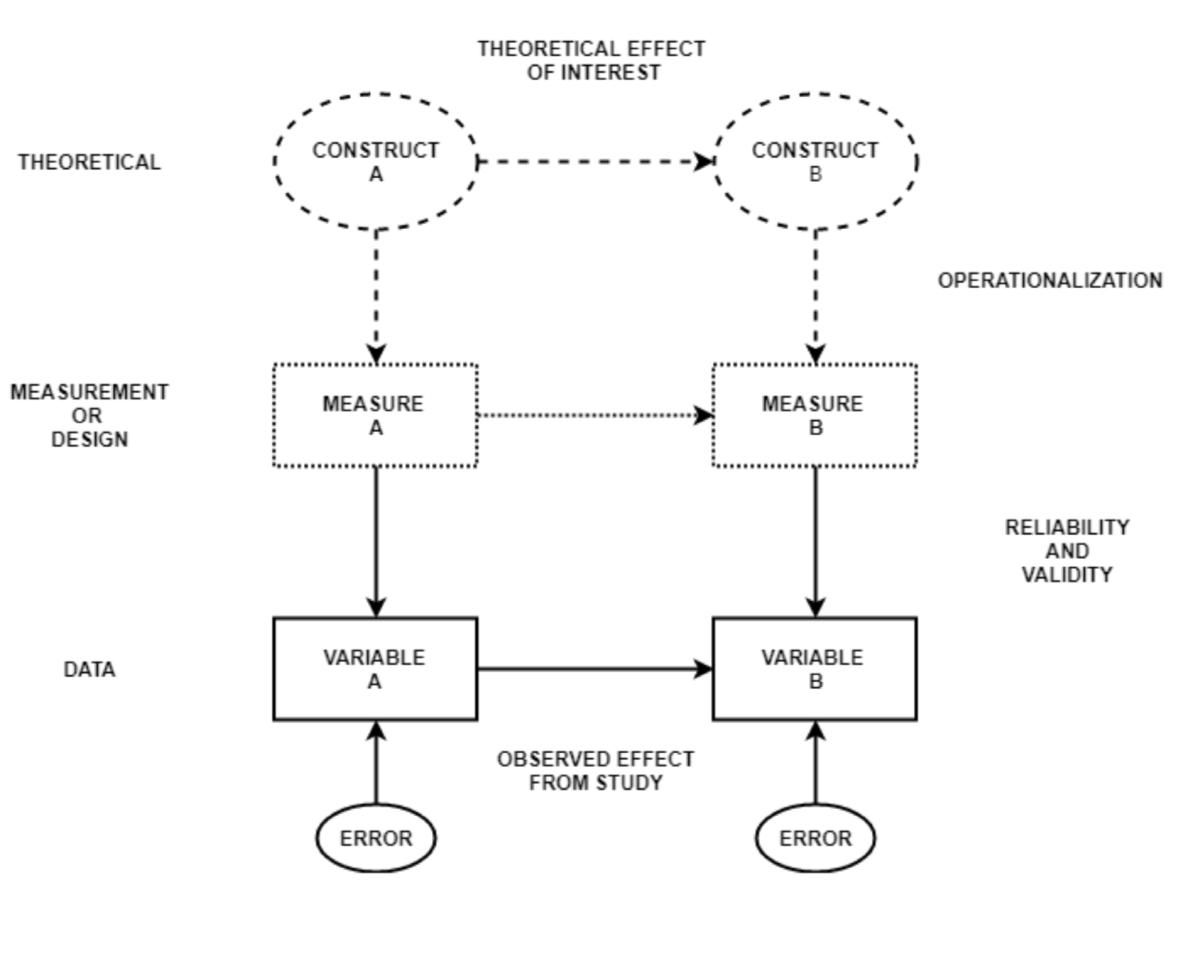
  4. Identify variables
    Decide what you will measure.

    • IV: Study_hours
    • DV: Overall_mark
  5. Collect data
    Gather values for these variables in a sample.

  6. Analyse data
    Summarise variables and test relationships.

  7. Interpret and conclude
    Relate the results back to the research question.

This week focuses on Step 4 because everything else depends on identifying variables correctly.


3. Variables in Research

A variable is any characteristic that varies between individuals.

In Lecture1_data.csv, variables include:

  • Gender, Degree, Exercise
  • Study_hours, Sleep_hours
  • Stress_level, Satisfaction_Likert_item
  • Overall_mark, IQ

Variables can be classified in two ways:

  1. By role — how they function in the research design
  2. By type — the kind of information they contain

3.1 Variables by Role: Independent and Dependent

Role What it does Example from the dataset
Independent variable (IV) Used to explain/predict something; sometimes manipulated Study_hours, Gender, Exercise
Dependent variable (DV) The outcome being measured Overall_mark, Sleep_hours, Stress_level

A simple way to remember:

IV → DV
“Does X influence / predict / relate to Y?”

Examples using the lecture dataset:

  • Does study time predict overall marks?
    • IV: Study_hours
    • DV: Overall_mark
  • Do students who exercisesleep more?
    • IV: Exercise
    • DV: Sleep_hours
  • Is stress level related to hours of study?
    • IV: Study_hours
    • DV: Stress_level

3.2 Manipulated vs Measured Variables

  • Manipulated variables
    • Assigned by the researcher (e.g. an experiment).

    • Not present in this dataset.

  • Measured variables
    • Naturally occurring characteristics recorded by the researcher.
    • All variables in Lecture1_data.csv are measured.

4. Variables in the Lecture Dataset

library(readr)
library(dplyr)

lecture <- read_csv("Lecture1_data.csv")
glimpse(lecture)
Rows: 200
Columns: 14
$ ID                        <chr> "S001", "S002", "S003", "S004", "S005", "S00…
$ Degree                    <chr> "Architecture", "Linguistics", "English", "P…
$ Year                      <dbl> 2, 1, 2, 1, 2, 2, 2, 3, 2, 2, 1, 3, 1, 1, 2,…
$ Gender                    <chr> "Female", "Male", "Female", "Male", "Non-bin…
$ Study_hours               <dbl> 6.8, 3.1, 8.2, 5.5, 4.0, 7.4, 2.7, 9.0, 5.9,…
$ Sleep_hours               <dbl> 7.4, 5.8, 7.6, 6.7, 5.9, 7.8, 5.0, 8.2, 6.6,…
$ Stress_level              <chr> "Moderate", "High", "Low", "Moderate", "High…
$ Satisfaction_Likert_item  <chr> "Satisfied", "Dissatisfied", "Very Satisfied…
$ Satisfaction_Likert_value <dbl> 4, 2, 5, 4, 2, 5, 1, 5, 4, 4, 2, 5, 3, 2, 5,…
$ Coffee_per_day            <dbl> 1, 3, 1, 2, 2, 1, 4, 0, 2, 1, 3, 0, 2, 3, 1,…
$ Social_media_hr           <dbl> 2.4, 4.7, 2.0, 3.0, 4.1, 2.1, 5.2, 2.5, 3.2,…
$ Exercise                  <chr> "Yes", "No", "Yes", "No", "No", "Yes", "No",…
$ Overall_mark              <dbl> 68, 55, 78, 65, 58, 74, 49, 81, 66, 70, 56, …
$ IQ                        <dbl> 102, 108, 95, 110, 99, 106, 88, 120, 100, 10…
Below is a description of all variables in the Lecture1_data.csv dataset.

Variable Name Description
ID Participant ID (unique identifier)
Degree Degree programme the student is enrolled in
Year Year of study (1, 2, 3 …)
Gender Self-reported gender
Study_hours Hours spent studying per day (continuous)
Sleep_hours Hours of sleep per night (continuous)
Stress_level Reported stress level (Low, Moderate, High)
Satisfaction_Likert_item Satisfaction rating (text: e.g. Satisfied)
Satisfaction_Likert_value Numerical coding of satisfaction (1–5)
Coffee_per_day Cups of coffee consumed per day (count)
Social_media_hr Time spent on social media per day (hours)
Exercise Whether the student exercises (Yes/No)
Overall_mark Overall module mark (%)
IQ Estimated IQ score

4.1 Variables by Type: Categorical and Numeric

We also classify variables by the kind of information they contain. This affects:

  • how we summarise them (counts, means, medians, etc.)
  • which plots we use (bar plots, histograms, boxplots, scatterplots)
  • which statistical tests are appropriate

4.1.1 Categorical variables

They group observations into labels.

Example variables in the lecture dataset:

  • Gender

  • Exercise

  • Degree

  • Stress_level

  • Satisfaction_Likert_item

  • Satisfaction_Likert_value (ordinal coded)

Subtypes

  • Nominal: no natural order (e.g. Gender, Degree)

  • Ordinal: meaningful order (e.g. Stress_level, Satisfaction ratings)

We summarise categorical variables using:

  • frequencies (counts)

  • percentages / proportions

  • bar plots

4.1.2 Numeric variables

Examples in the lecture dataset:

  • Study_hours

  • Sleep_hours

  • Overall_mark

  • IQ

  • Coffee_per_day

  • Social_media_hr

Subtypes:

  • Discrete (counts): Coffee_per_day

  • Continuous (measurements): Study_hoursIQSleep_hours

We summarise numeric variables using:

  • means, medians

  • standard deviation, IQR

  • histograms, boxplots, scatterplots


5. Levels of Measurement

In Lecture 01 you met four classic levels of measurement. Here we briefly reconnect them to research design, using variables from the Lecture1_data.csv dataset.

Level Meaning Examples (lecture dataset)
Nominal Categories with no intrinsic order Gender, Degree, Exercise
Ordinal Ordered categories, unequal gaps Stress_level, Satisfaction_Likert_value
Interval Numeric, equal spacing, no true zero IQ (treated as an approximate interval scale in psychology)
Ratio Numeric, equal spacing, true zero Study_hours, Sleep_hours, Overall_mark, Coffee_per_day, Social_media_hr

In practice we often talk simply about categorical vs numeric variables, but levels of measurement sit in the background and influence what is sensible:

  • you would not normally compute a mean of nominal data
  • you should be cautious interpreting means of ordinal scales
  • most parametric tests (e.g. t-tests, correlation) assume numeric (interval/ratio) data

6. Exercise: Classifying Variables in the Lecture Dataset

Use the variables from Lecture1_data.csv to practise identifying:

  1. whether each variable is categorical or numeric
  2. the level of measurement
  3. whether it could be an IV, a DV, or either

Consider the following variables:

  • Gender
  • Exercise
  • Study_hours
  • Overall_mark
  • Stress_level
  • Coffee_per_day
  • Social_media_hr

Your Task

Complete the table below by filling in the Type, Level, and Possible Role(s) for each variable.

Variable Type (Categorical/Numeric) Level Possible Role(s)
Gender
Exercise
Stress_level
Study_hours
Overall_mark
Coffee_per_day
Social_media_hr

Now write one possible research question using any two variables above.

Example format:

  1. “Does ___ predict ___?”
  2. “Do ___ and ___ differ in ___?”
  3. “Is there an association between ___ and ___?”

Classification Table

Variable Type Level Possible Role(s)
Gender Categorical Nominal IV (grouping variable)
Exercise Categorical Nominal IV or DV
Stress_level Categorical Ordinal IV or DV
Study_hours Numeric Ratio IV or DV
Overall_mark Numeric Ratio DV (usually an outcome)
Coffee_per_day Numeric Discrete IV
Social_media_hr Numeric Ratio IV or DV

Example research questions

  • Does study time predict overall marks?
  • Do students who exercise sleep more?
  • Are stress levels associated with time spent on social media?
  • Do male and female students differ in their study hours?