10**(seq(from=0, to=110, by=10)/10) [1] 1e+00 1e+01 1e+02 1e+03 1e+04 1e+05 1e+06 1e+07 1e+08 1e+09 1e+10 1e+11A couple of these problems mention R, but no coding is required! They are mostly pen and paper exercises, though a few of them ask you to create plots or look something up online.
The solution to the decibel problem in last week’s workshop used a little snippet of R code,
10**(seq(from=0, to=110, by=10)/10) [1] 1e+00 1e+01 1e+02 1e+03 1e+04 1e+05 1e+06 1e+07 1e+08 1e+09 1e+10 1e+11In this is R’s seq function which generates a sequence of values. It takes some starting value from, a final value to, and a common difference by, then uses those to create an arithmetic sequence.
How would the sequence seq(from=0, to=110, by=10) be defined as \(a_n\) mathematically?
Code seq(...)/10 divides this by ten. What’s the definition \(b_n\) of the divided sequence?
Finally, in 10**(...), each term is used as a power of ten. What’s this final sequence, \(c_n\)?
A common pitfall is confusing the terms ‘sequence’ (a list) and ‘series’ (a sum). For example, the strictly positive integers \(a_1 = 1\), \(a_2 = 2\), etc are a sequence \(a_n = n\). On the other hand their sum, \(1 + 2 + \ldots\), is a series.
What is \(\sum_{n=1}^{10} a_n\)?
What’s the sum of the first \(n\) strictly positive integers?
After seeing a video online, Charlie is convinced \(\sum_{n=1}^{\infty} n = -\frac{1}{12}\). Justify why this is not true.
Long before the advent of analytical methods for working with infinite series, ancient philosophers wrestled with their seemingly paradoxical nature. For example in the Chinese Zhuangzi (~300 BCE),
If from a stick a foot long you every day take the half of it, in a myriad ages it will not be exhausted.
Lets say that the length of the stick on day \(d\) is denoted \(L_d\).
Find an expression for \(L_d\) in terms of \(L_{d-1}\) (i.e. the day before).
Find an expression for \(L_d\) that only depends on \(d\).
Charlie argues that our formulation can’t be correct because the paradox says to ‘take’ half the stick away, so any correct formula must involve a subtraction. They present the following answer: \[ L_d = 1 - \sum_{n=1}^d \frac{1}{2^n}. \]
There are many weird and wonderful sequences and series. A common one you might have heard of is Fibonacci’s sequence, defined \[ F_n = \begin{cases} 0 & \text{if}~n = 0, \\ 1 & \text{if}~n = 1, \\ F_{n-1} + F_{n-2} & \text{if}~n \geq 2. \end{cases} \] This gives 0, 1, 1, 2, 3, 5, 8, 13, 21, 34, and so on; this links into the Golden Ratio.
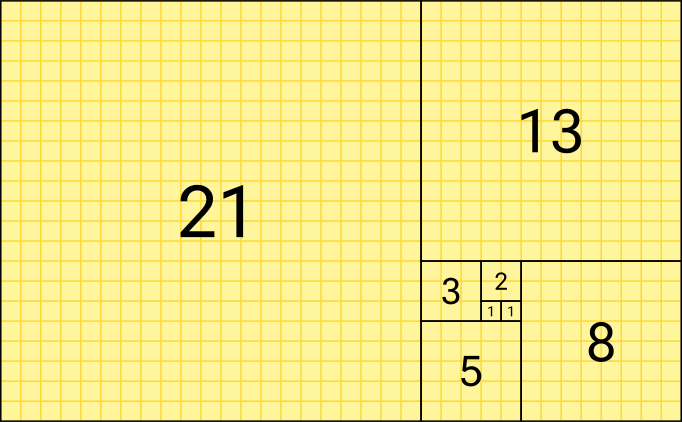
The Online Encyclopaedia of Integer Sequences (OEIS) tracks this as sequence A000045 (along with 388839 others) and includes some more mathematical, historical, and usage information.
Define a general sequence \(a_n\) however you wish, and calculate its first eight terms are.
Search those terms in OEIS to see if it’s a existing, named sequence.
Is there a geometric interpretation of the sequence you’ve found?
